Title: Extracorporeal Blood Oxygenation and Ozonation (EBOO): A Review of Clinical Mechanisms and Therapeutic Potential
- Randy Justus
- Apr 30
- 3 min read

Updated: 3 days ago
Disclaimer: This paper is for informational and educational purposes only, based on research available as of early 2026. It does not provide medical advice or endorse the use of unapproved compounds.
This information is for informational purposes only and does not replace professional medical advice. Always consult a licensed healthcare provider for concerns about your health.
Abstract
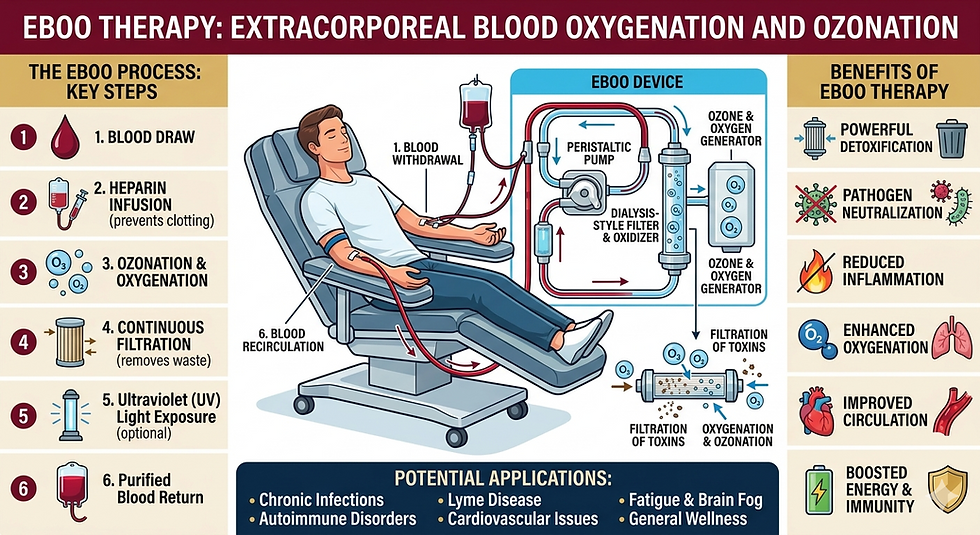
EBOO is an ex vivo blood filtration technique designed to treat large volumes of blood with a mixture of oxygen and ozone. Unlike standard ozone therapies that process small amounts of blood, EBOO can treat 3 to 4 liters in a single session. This review explores its clinical applications in peripheral arterial disease (PAD), chronic infections, and systemic detoxification.
1. Introduction
Traditional ozone therapy, such as Major Autohemotherapy (MAH), typically treats only a few hundred milliliters of blood. EBOO represents a "closed-circuit" evolution, utilizing a medical pump and a specialized gas exchanger (filter) to expose the patient’s entire blood volume to therapeutic gases. This method aims to improve cellular metabolism, enhance immune response, and reduce oxidative stress.
2. Mechanisms of Action
The primary therapeutic benefits of EBOO stem from several biological pathways:
Antioxidant Activation: EBOO elicits moderate, transient oxidative stress, which activates the Nrf2 transcriptional factor. This stimulates the production of antioxidant enzymes like superoxide dismutase and glutathione.
Enhanced Oxygenation: Ozone acts as a stimulator for the transmembrane flow of oxygen, making the mitochondrial respiratory chain more efficient.
Systemic Filtration: Beyond gas exchange, EBOO uses an integrated filtration system to remove metabolic waste, heavy metals, and inflammatory markers.
3. Clinical Applications
Peripheral Artery Disease (PAD): Controlled trials have shown significant regression of skin lesions and improvement in patient well-being compared to standard prostacyclin treatments.
Detoxification: Case reports documented an average 64.8% decline in mycotoxins and a 25.7% decline in heavy metals (e.g., lead, mercury) after a series of treatments.
Infectious and Inflammatory Diseases: EBOO has been utilized for conditions like necrotizing fasciitis, viral hepatitis, and chronic fatigue syndrome.
4. Safety and Contraindications
EBOO is generally well-tolerated with no recorded side effects in early clinical trials. However, there is one absolute contraindication:
Glucose-6-Phosphate Dehydrogenase (G6PD) Deficiency (Favism): Due to the risk of acute hemolytic anemia.
5. Conclusion
EBOO offers a high-volume, efficient delivery system for medical ozone, surpassing the limitations of traditional MAH. While preliminary results in vascular and toxicological health are promising, further extensive clinical trials are necessary to standardize protocols and validate long-term efficacy.
Key Resources for Further Study
Clinical Studies: Review the full EBOO PAD trial and detoxification case reports .
Standard Operating Procedures: Refer to the ISCO3 guidelines for technical safety details.
Would you like to explore a specific medical condition or focus more on the biochemical mechanisms of ozone in the blood?
References
Extracorporeal blood oxygenation and ozonation: clinical and biological implications of ozone therapy https://pubmed.ncbi.nlm.nih.gov/16156950/
Extracorporeal blood oxygenation and ozonation (EBOO): a controlled trial in patients with peripheral artery disease https://pubmed.ncbi.nlm.nih.gov/16288443/
Hydrozone Gaseous Arthrodiastesis, EBOO/MAHT, and Low Dose Methotrexate in Ficat Grade 3/4 Avascular Necrosis of Hip Joints in Young Patients https://www.actascientific.com/ASOR/pdf/ASOR-08-1051.pdf
Antimicrobial and Immune System Benefits of EBOO https://www.infinityhydrationwellness.com/post/research-supporting-extracorporeal-blood-oxygenation-and-ozonation-eboo
Observed Reduction in Urinary Toxin Excretion With Extracorporeal Blood Oxygenation and Ozonation (EBOO) Treatment in an 88-Year-Old With Chronic Anemia: A Case Report https://pubmed.ncbi.nlm.nih.gov/41583215/
Extracorporeal Blood Oxygenation and Ozonation (EBOO): A Controlled Trial in Patients with Peripheral Artery Disease https://journals.sagepub.com/doi/10.1177/039139880502801012
EBOO Therapy Clinical Research Breakthroughs Unveiled https://drbloem.com/eboo-therapy-insights-from-latest-clinical-research-breakthroughs/


Comments