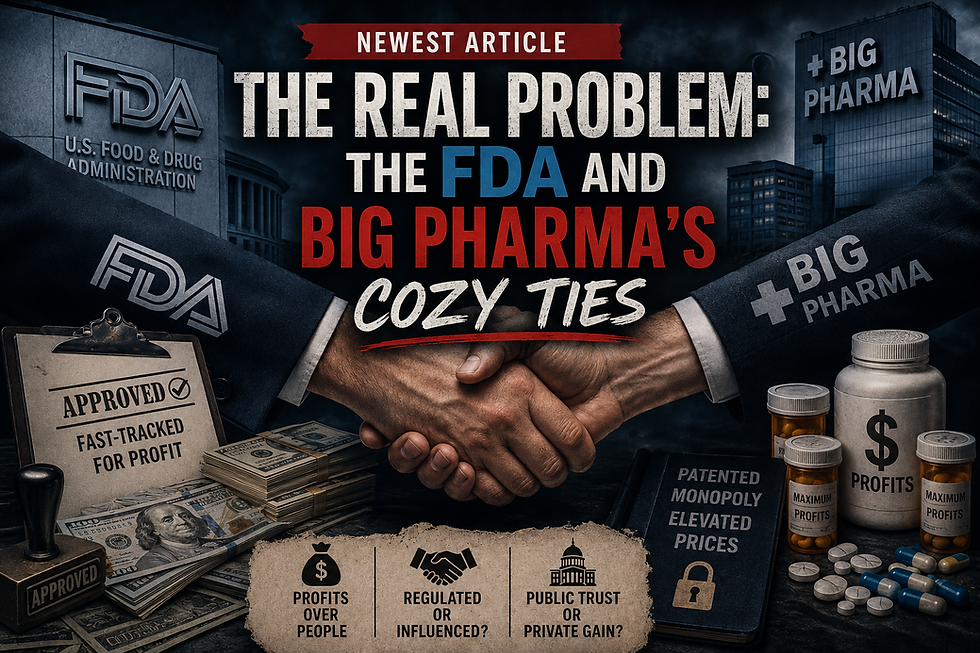
The Real Problem: The FDA and Big Pharma’s Cozy Ties

Disclaimer: This paper is for informational and educational purposes only, based on research available as of early 2026. It does not endorse the use of unapproved compounds. This information is for informational purposes only and does not replace professional medical advice. Always consult a licensed healthcare provider for concerns about your health.
Recent FDA reviews recommend restricting access to seven popular peptides, citing a lack of clinical evidence. However, the debate over this regulation highlights a systemic issue: deep financial and political ties between the FDA and Big Pharma, which critics argue stifles alternative therapies in favor of heavily patented, expensive drugs.
The FDA’s Latest Peptide Stance: Safety Concerns vs. Access
Peptides—short chains of amino acids naturally produced by the body—have surged in popularity for health, longevity, and athletic recovery. In July, the FDA's Pharmacy Compounding Advisory Committee (PCAC) met to evaluate whether to permit compounding pharmacies to legally manufacture seven sought-after peptides, including BPC-157, TB-500, and Semax.
Despite a push from Health and Human Services (HHS) Secretary Robert F. Kennedy Jr. to loosen restrictions and reverse a 2023 FDA ban on 19 peptides, career FDA scientists pushed back. Agency reviewers flagged the lack of large-scale human clinical trials, warning that unapproved substances often carry risks related to immunogenicity, dosing, and contamination.
The Real Problem: The FDA and Big Pharma’s Cozy Ties
While the FDA frames its peptide restrictions purely around safety, many industry experts and critics point to a deeper, more systemic issue: the close, symbiotic relationship between the agency and major pharmaceutical companies.
1. The Patent Trap
Many popular peptides are naturally occurring molecules or variations thereof. Pharmaceutical companies typically cannot secure robust patent protections for natural substances. Because the financial risk of conducting massive, hundred-million-dollar FDA clinical trials requires strong patent protection to ensure a return on investment, Big Pharma rarely funds research into these molecules. Consequently, they remain in the compounding sector, and the FDA moves to restrict them for lacking the very Phase III clinical trials that Big Pharma refuses to fund.
2. The Revolving Door and Financial Dependencies
The ties between the regulator and the regulated are well-documented. The FDA relies heavily on "user fees" paid by pharmaceutical companies to review drugs, creating a financial incentive to keep mass-market approval as the only viable path to market. Furthermore, a well-established revolving door sees former FDA officials taking lucrative executive and consulting roles at top pharmaceutical corporations, raising concerns that the agency acts to protect the monopolies of massive drug makers.
3. Banning Compounding to Secure Monopolies
Major pharmaceutical companies generally dislike compounding pharmacies because they circumvent the monopolies held by mass-market drug manufacturers. When the FDA issues blanket restrictions on compounded peptides, it effectively clears the way for Big Pharma to take over the market. If and when clinical studies do prove a peptide's efficacy, traditional pharmaceutical giants will likely synthesize the molecule, patent a unique delivery mechanism, and charge premium prices, pricing out the very consumers who previously relied on affordable compounded alternatives.
References


Comments